Payload Threat Actor Ransomware
Deep Technical Analysis Of Payload Ransomware
Payload Threat Actor
The current information about this new threat actor in the wild till this moment is little , but according to Ahmed Elessaway , It is active since 17-02-2026 and till this moment has targets between United States , Philippines , Mexico , United Kingdom and Egypt , and it reached 26 victims.
Victims
United Finance Egypt
Tscherne Consulting Steuerberatung GmbH
SAYEGH
NKAR Travels & Tours
Q2 Artificial Lift Services
Don-Nan
A A Al Moosa Enterprises (ARENCO Group)
carlysle.net
Vancompare Insurance
iGLS
HOPPECKE Singapore
TS Lines Philippines
Lucky Innovative Manufacturing Corporation
Notaría 89
Royal Bahrain Hospital
J.T. Pack of Foods
Grid Fine Finishes
Alcoholes Finos Dominicanos
In.Sa.Cor
Easy Servizi
Thai Solar Energy Public
United Limsun International Trading
Tyler Media
Río Grande (Puerto Rico)
sodic.com
Almacenes Distribuidores de la Frontera
Sample information
| Field | Value |
|---|---|
| File name | locker_esxi.elf |
| File format | ELF64 Linux x86-64 |
| File size | 0x9BE0 (stripped on disk, 0x2097A8 mapped) |
| MD5 | f91cbdd91e2daab31b715ce3501f5ea0 |
| SHA1 | 0252819a4960c56c28b3f3b27bf91218ffed223a |
| SHA256 | bed8d1752a12e5681412efbb8283910857f7c5c431c2d73f9bbc5b379047a316 |
Executive Summary
locker_esxi.elf is a 64-bit Linux ELF ransomware binary targeting VMware ESXi hypervisor environments . The sample combines a robust cryptographic scheme Curve25519 ECDHand ChaCha20 with ESXi-specific VM enumeration via the vmInventory.xml inventory file, graceful shutdown of running VMs before encryption, and a multi-threaded file encryption pipeline scaled to available CPU cores. The ransom note is delivered inside ESXi’s own web UI welcome.txt, replacing the host management interface greeting.
String Decryption
The binary embeds its configuration as RC4-encrypted and base64-encoded blobs in the .rodata section. The RC4 key is the three-byte FBI. All sensitive strings , file paths , error messages and shell commands are decrypted at runtime through mw_w_RC4().
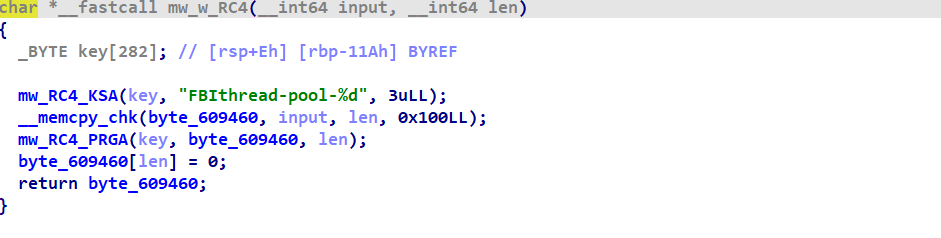 Figure(1) mw_w_RC4() Decryption Function
The python decryption script below to decrypt data blobs in place in IDA to make the analysis more easier.
1
2
3
4
5
6
7
8
9
10
11
12
13
14
15
16
17
18
19
20
21
22
23
24
25
26
27
28
29
30
31
32
33
34
35
36
37
38
39
40
41
42
43
44
45
46
47
48
49
50
51
52
53
54
55
56
57
58
59
60
61
62
63
64
import idc
import idaapi

def rc4(key: bytes, data: bytes) -> bytes:
    S = list(range(256))
    j = 0
    for i in range(256):
        j = (j + S[i] + key[i % len(key)]) % 256
        S[i], S[j] = S[j], S[i]

    result = bytearray()
    i = j = 0
    for byte in data:
        i = (i + 1) % 256
        j = (j + S[i]) % 256
        S[i], S[j] = S[j], S[i]
        result.append(byte ^ S[(S[i] + S[j]) % 256])
    return bytes(result)


RC4_KEY = b"FBI"

BLOBS = [
    (0x6093F0, 0x12),
    (0x6092A0,   33),
    (0x609288,   13),
    (0x609260,   14),
    (0x60925A,    5),
    (0x609250,   10),
    (0x609270,   18),
    (0x609300,   34),
    (0x609380,   43),
    (0x609330,   22),
    (0x609350,   28),
    (0x609220,   44),
    (0x6092D0,   30),
    (0x6093D0,   31),
    (0x6093B0,   20),
]


def patch_blob(ea: int, plaintext: bytes) -> None:
    for offset, byte in enumerate(plaintext):
        idc.patch_byte(ea + offset, byte)
    idc.patch_byte(ea + len(plaintext), 0)


def make_string(ea: int, length: int) -> None:
    idaapi.del_items(ea, idaapi.DELIT_SIMPLE, length + 1)
    idc.create_strlit(ea, ea + length + 1)


def main():
    for ea, size in BLOBS:
        data = idc.get_bytes(ea, size)
        if data is None:
            continue
        plaintext = rc4(RC4_KEY, data)
        patch_blob(ea, plaintext)
        make_string(ea, size)


if __name__ == "__main__":
    main()
Decrypted strings:
Show List
set_key(): failed!
[!] base64 pubkey decode failed
[!] invalid key size
vim-cmd vmsvc/power.off %d > /dev/null 2>&1
vm=%d successful turned off!
can't turn off vmid=%d
decode_base64(): failed to decode!
set_note(): failed to open: %s
/etc/vmware/hostd/vmInventory.xml
//ConfigEntry
xmlReadFile failed
no ConfigEntry
bjID
vmcfgPath
/usr/lib/vmware/hostd/docroot/ui/welcome.txt
Technical Analysis
Anti-Analysis & Defense Evasion
Malware immediately at beginning checks if debugger attached to the process by opening /proc/self/status and reads lines until it finds TracerPid:, if the integer following that field is non-zero so debugger is attached , execution branches to delete itself.
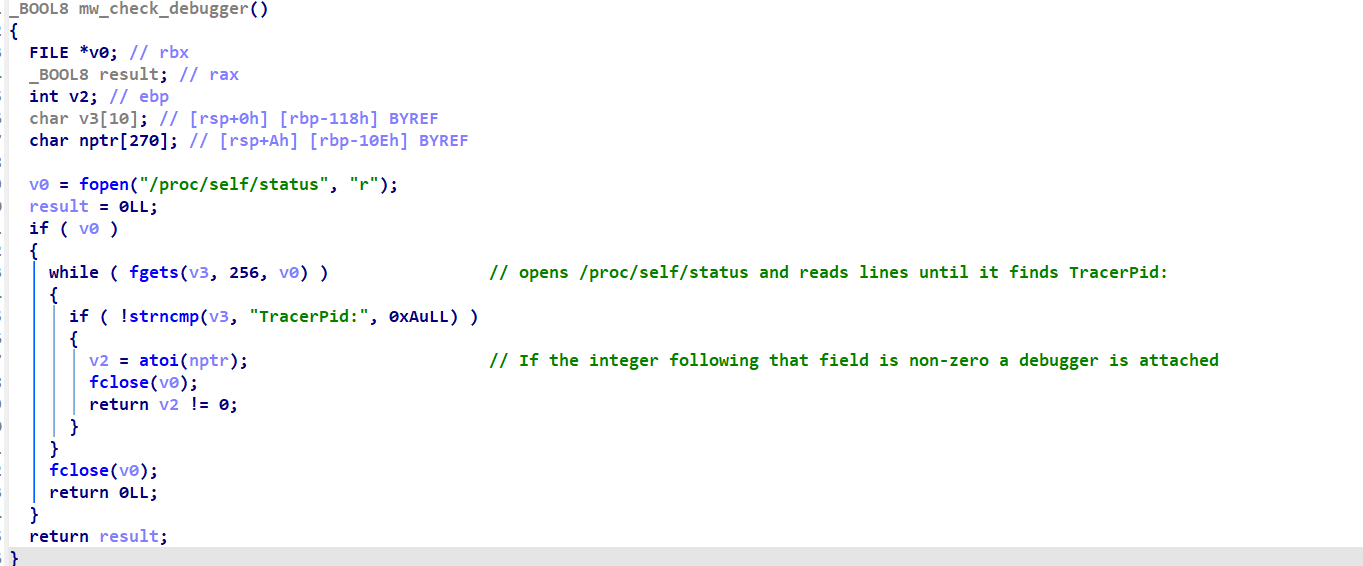 Figure(2) Malware checking for debugger
Cryptographic Scheme
The cryptographic scheme takes stages before doing the actual encryption such as encryption public key extraction , gathering CPU capabilities , encryption routine selection , thread-pool initialization and finally multi-thread encryption job.
Public Key extraction
The malware encodes its public key via Base-64 encoding shown in figure below , which reveling the public encryption key is 3E67A9F94526785C31C543BE3F4DC7039E7C3F764F65637C6C22B85F3357B575. 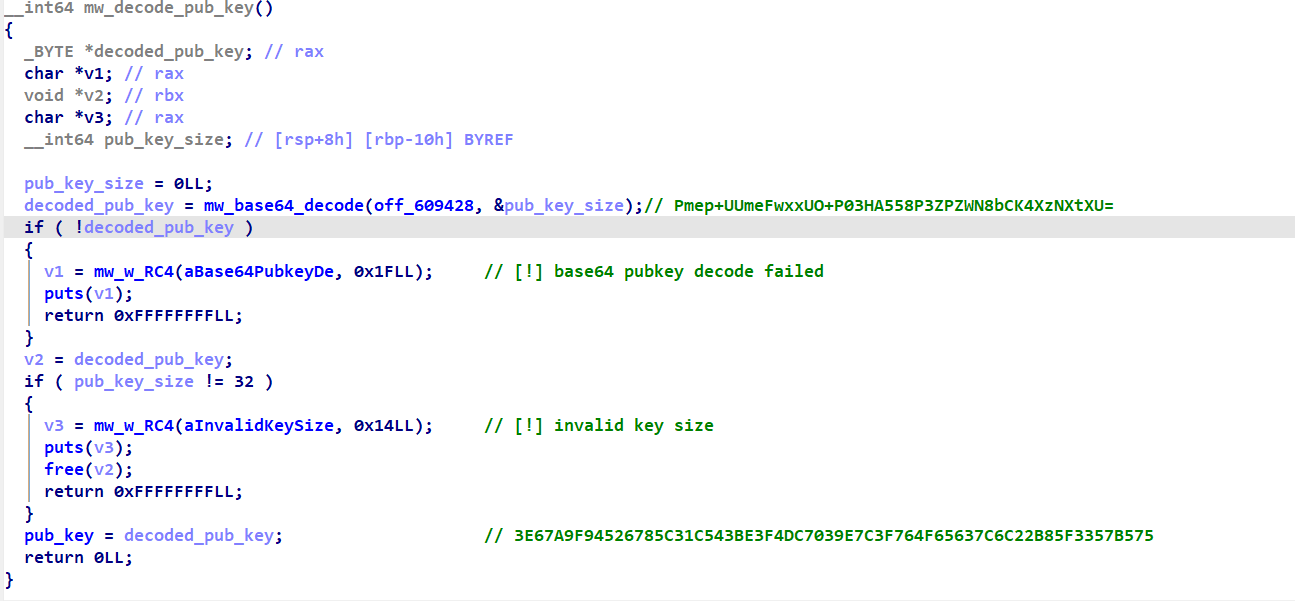 Figure(3) Public Key Extraction
Gathering CPU Capabilities
The malware wants to run ChaCha20 as fast as possible, so before any encryption happens it probes the CPU for SIMD capabilities and stores a function pointer to the fastest available implementation. Every subsequent file encryption call goes through that pointer without re-checking. 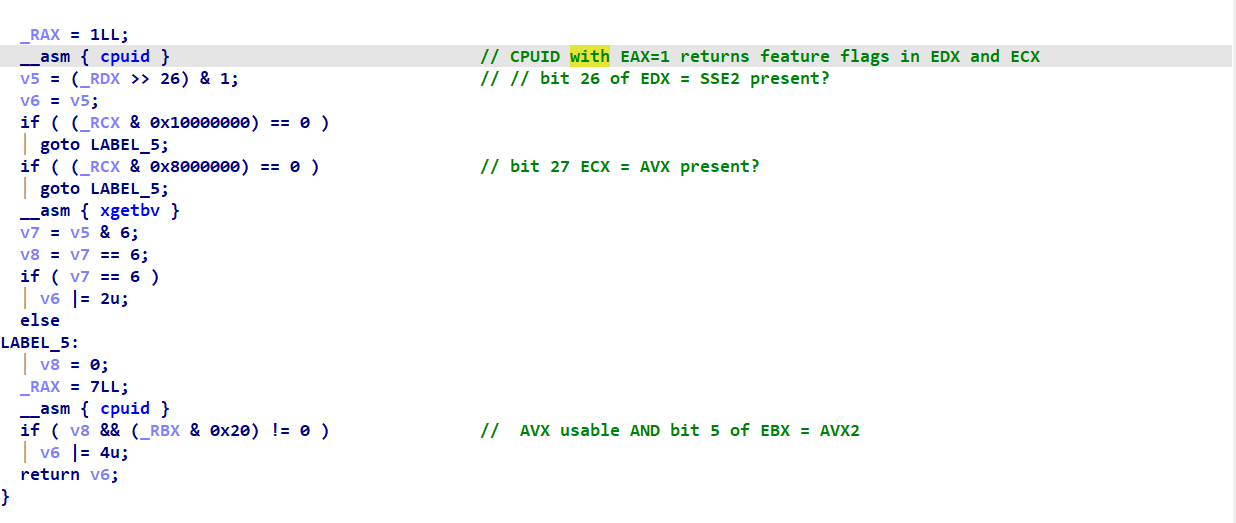 Figure(4) Gathering CPU Capabilities The function queries processor feature flags via
 CPUID and XGETBV:
- Checks SSE2 support via
EDX bit 26. - Checks AVX support via
ECX bits 28/27. - Uses
XGETBVto confirm OS-level AVX state (XSAVE enabled state validation). - Queries extended features
CPUID leaf 7to detect AVX2 support (EBX bit 5).
The resulting capability mask is built as:
bit 0value 0 so SSE2 available.bit 1value 1 so AVX usable.bit 2value 4 so AVX2 available. This behavior is consistent with performance-aware malware or protected loaders that adapt cryptographic implementations based on host hardware capabilities.
Encryption Routine Variants
Based on the CPU capabilities it decides between which routine will handle the encryption logic. 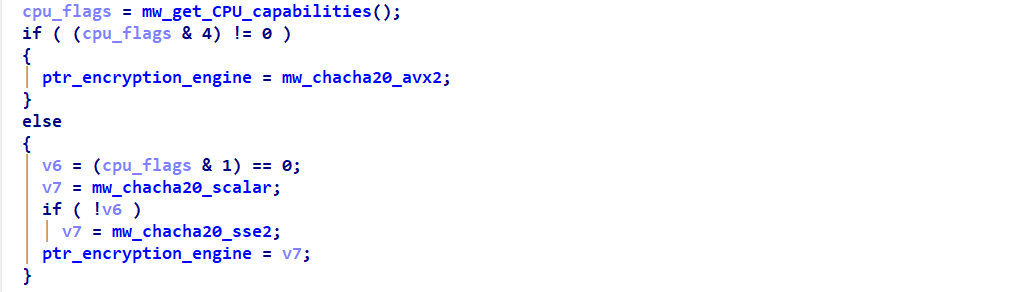 Figure(5) Encryption routine selection
mw_chacha20_scalar
- Pure scalar implementation using 32-bit general-purpose registers (
EAX,EBX,ECX, etc.) - Entire ChaCha20 state maintained as individual integers (heavily stack-spilled).
- Rotations implemented manually via
__ROL4__(shift + OR). - Processes 1 block (64 bytes) per iteration.
- Block counter increments by +1.
- Simple control flow:
- Single loop of 10 double-rounds.
- Followed by a separate add-back phase.
- XOR with plaintext performed 4 bytes at a time.
- Most portable but least performant variant.
mw_chacha20_sse2
- Uses 128-bit XMM registers with VEX-encoded SSE instructions:
vpaddd,vpxor,vpshufd,vpslld,vpsrld. - Implements 4-way parallelism each XMM lane represents one block and processes 4 blocks simultaneously.
- Counter initialization: uses
vpaddqwith precomputed constants to generate 4 parallel counters. - Block counter increments by +4 per iteration.
- Rotation strategy:
- Bit rotations via shift+OR.
- Lane permutations via
vpshufd(shuffles0x93,0x4E,0x39).
- Output: XOR and writes using XMM registers 16 bytes per store.
- Loop structure:
- Outer loop 256-byte aligned chunks (4×64).
- Tail loop remaining 64-byte blocks.
- Sub-64-byte remainder handled via stack buffer staging.
mw_chacha20_avx2
- Fully utilizes 256-bit YMM registers.
- Implements 8-way parallelism each YMM lane holds one word across 8 blocks.
- Setup phase:
vbroadcasti128used to duplicate key/state across YMM lanes. - Advanced data movement:
vperm2i128enables cross-lane shuffling (critical for 8-block transposition). - Block counter increments by +8 per iteration.
- Rotation optimization: uses
vpshufbwith precomputed masks which faster than shift+OR. - Output: writes 32 bytes per store (double SSE2 throughput).
- Loop hierarchy:
- Main loop 512-byte aligned chunks (8×64)
- Secondary loop 128-byte tail
- Final stage fine-grained remainder handling (branching per 32-byte boundary)
And the figure below explains the stages of every routine
Thread Pool Execution
The sample initializes a multi-threaded processing pipeline by creating a thread pool sized at 2× the number of CPU cores, indicating intent for high-throughput file operations.
It accepts an optional command-line exclusion list (-i), allowing specific ports to be skipped during execution suggesting operator-controlled targeting or selective encryption.
The malware then accesses a VMware ESXi configuration file (/etc/vmware/hostd/vmInventory.xml), with both the file path and XPath query (//configentry) RC4-obfuscated , It parses <configentry> nodes to extract port identifiers (used as directory references) datastore paths(VM storage locations).
The malware then iterates over collected directories and:
- Enumerates files within each directory.
- Skips files already marked as encrypted (suffix .xx0001).
- Submits remaining files as jobs to the thread pool for encryption via
mw_encrypt_file.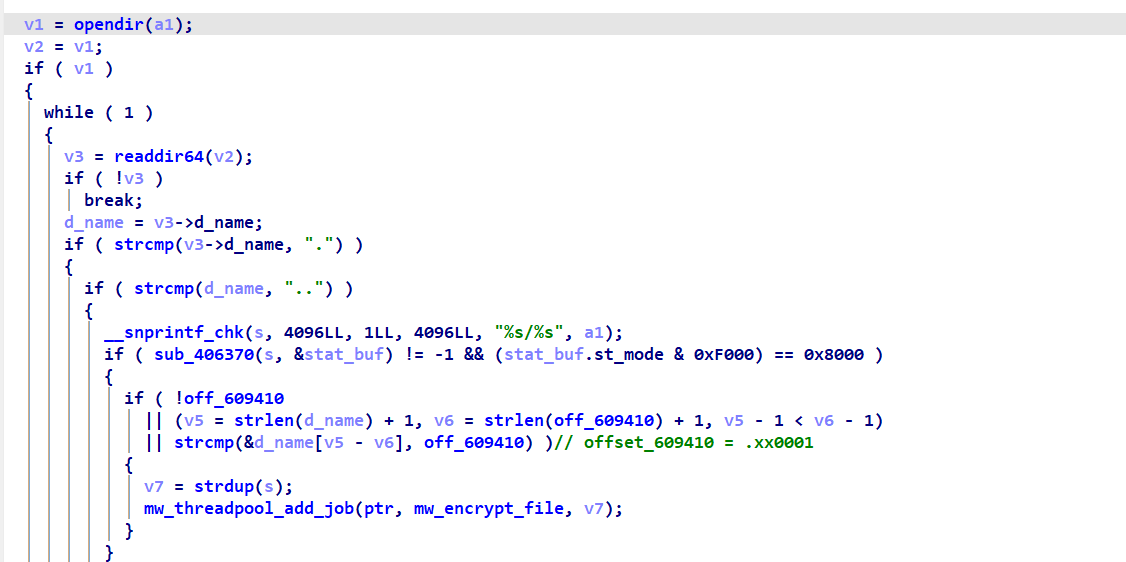 Figure(7) Malware encrypts files and suffix .xx0001
Each worker thread on startup calls prctl(PR_SET_NAME, "FBIthread-pool-%d") — the thread name string FBIthread-pool-%d is embedded in plaintext and is a notable forensic indicator. On wakeup, a thread dequeues a job, executes it as job->fn(job->arg), frees the job struct, and decrements the active-job counter. If the active count drops to zero, a pthread_cond_signal is fired to unblock any waiting caller of threadpool wait.
Encryption Routine
The function implements a targeted, in-place ransomware encryption workflow optimized for ESXi/VMware environments. It exclusively processes files larger than 5 GB, effectively filtering for virtual disk images such as VMDK while ignoring smaller files, indicating deliberate high-value targeting.
Each file undergoes a per-file Curve25519 ECDH key exchange, generating a unique ephemeral key pair and deriving a ChaCha20 encryption key from a decoded attacker public key. This ensures strong cryptographic isolation, preventing decryption without attacker-controlled material.
Encryption is performed partially across 5 segments, each up to 1 GB, using a 1 MB sliding buffer and executed in-place (no temporary files). The ChaCha20 keystream is synchronized with file offsets, enabling deterministic decryption while significantly reducing processing time—typical optimizing for speed on large datasets. 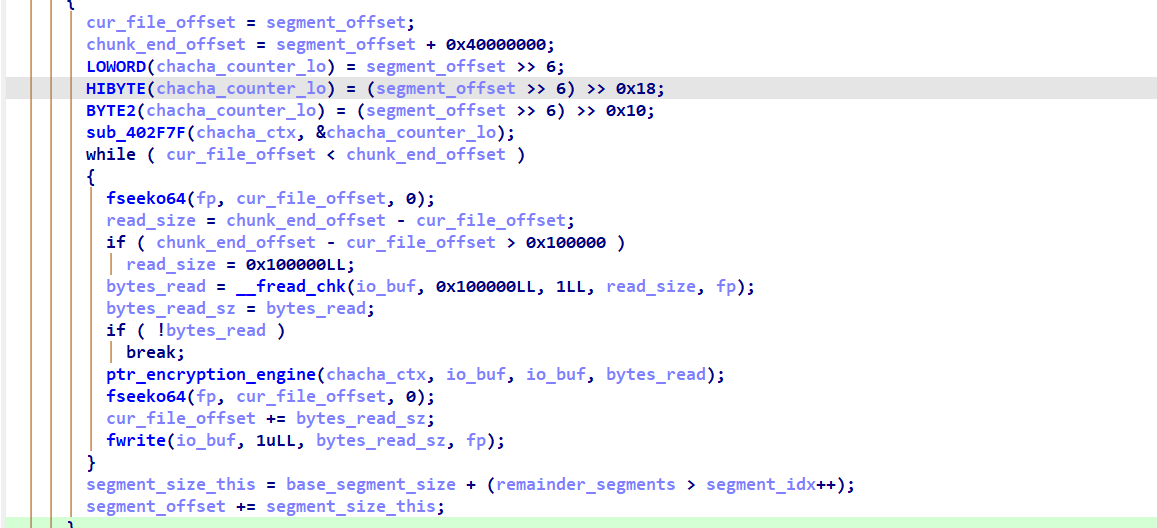 Figure(8) Encryption routine
Post-encryption, the malware appends a 56-byte footer containing the ephemeral public key, lightly obfuscated using RC4 3-byte key(“FBI”). This serves as metadata for decryption while providing minimal resistance to static extraction. Sensitive key material is explicitly wiped from memory, reflecting anti-forensic intent.
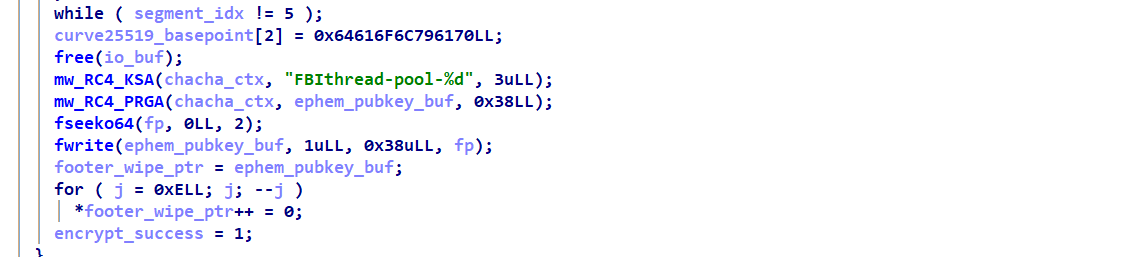 Figure(9) Metadata For Decryption
Ransom Note
The ransom note inside ESXi’s own web UI welcome.txt, replacing the host management interface greeting.
1
2
3
4
5
6
7
8
9
10
11
12
13
14
15
16
17
18
19
20
21
22
23
24
25
26
27
28
29
30
31
32
33
34
35
36
37
38
39
40
41
42
43
Welcome to Payload!

The next 72 hours will determine certain factors in the life of your company:
the publication of the file tree, which we have done safely and unnoticed by all of you,
and the publication of your company's full name on our luxurious blog.
NONE of this will happen if you contact us within this time frame and our negotiations are favorable.

We are giving you 240 hours to:
1. familiarize yourself with our terms and conditions,
2. begin negotiations with us,
3. and successfully conclude them.
The timer may be extended if we deem it necessary (only in the upward direction).
Once the timer expires, all your information will be posted on our blog.

ATTENTION!
Contacting authorities, recovery agencies, etc. WILL NOT HELP YOU!
At best, you will waste your money and lose some of your files, which they will carefully take to restore!
You should also NOT turn off, restart, or put your computer to sleep.
In the future, such mistakes can make the situation more expensive and the files will not be restored!
We DO NOT recommend doing anything with the files, as this will make it difficult to recover them later!

When contacting us:
you can request up to 3 files from the file tree,
you can request up to 3 encrypted files up to 15 megabytes
so that we can decrypt them and you understand that we can do it.

First, you should install Tor Browser:
1. Open: https://www.torproject.org/download
2. Choose your OS and select it
3. Run installer
4. Enjoy!

In countries where tor is prohibited, we recommend using bridges,
which you can take: https://bridges.torproject.org/

You can read:
[NOPE 3eb] (Tor)

To start negotiations, go to [NOPE] and login:
User: [snip]
Password: [snip]

Your ID to verify: [snip]
MITRE ATT&CK Coverage
| ID | Technique | Description |
|---|---|---|
| T1622 | Debugger Evasion | TracerPid check + self-deletion |
| T1027 | Obfuscated Files/Info | RC4 string obfuscation |
| T1036.005 | Process Masquerading | prctl thread name spoofing |
| T1070.004 | File Deletion | Self-deletes binary on detection |
| T1082 | System Info Discovery | CPUID, sysconf |
| T1083 | File and Directory Discovery | opendir / readdir64 |
| T1486 | Data Encrypted for Impact | ChaCha20 |
| T1490 | Inhibit System Recovery | Targets VMDK / datastore images |
| T1059.004 | Unix Shell Execution | vim-cmd via system() |
IOCs
- Files bearing
.xx0001extension on ESXi datastores - 56-byte footer containing hex magic
70 61 79 6C 6F 61 64 00 - Processes named FBIthread-pool-0, FBIthread-pool-1, … visible in ps/top
- Ransom note present at
/usr/lib/vmware/hostd/docroot/ui/welcome.txt
YARA Rule
1
2
3
4
5
6
7
8
9
10
11
12
13
14
15
16
17
18
19
20
21
22
23
24
25
26
27
28
29
30
31
32
33
34
35
36
37
38
39
40
41
42
43
44
45
46
47
48
49
50
51
52
53
54
55
56
57
58
59
60
61
62
63
64
65
66
67
68
69
70
71
72
73
74
75
76
77
78
79
80
81
82
rule payload_ransomware
{
    meta:
        description      = "Payload Ransomware "
        author           = "Abdullah Islam @0x3oBAD"
        date             = "2026-04-05"
        md5              = "f91cbdd91e2daab31b715ce3501f5ea0"
        sha256           = "bed8d1752a12e5681412efbb8283910857f7c5c431c2d73f9bbc5b379047a316"
        malware_family   = "ESXi Ransomware Locker"
        target_platform  = "Linux / VMware ESXi"

    strings:
        $pubkey_1        = "TnJqU2F5RFFYREpPTURkUGx5Q3NMem0yNlZKM0s1aks=" ascii
        $pubkey_2        = "Pmep+UUmeFwxxUO+P03HA558P3ZPZWN8bCK4XzNXtXU=" ascii
        $pubkey_head     = "W2M6q8YwDKCcSvBj7YRjVNtSI/PO22G+" ascii

        $ext             = ".xx0001" ascii nocase
        $thread_name     = "FBIthread-pool-%d" ascii

        $thpool_1        = "thpool_init(): Could not allocate memory for thread pool" ascii
        $thpool_2        = "thpool_init(): Could not allocate memory for threads" ascii
        $thpool_3        = "thpool_init(): Could not allocate memory for job queue" ascii
        $thpool_4        = "thpool_add_work(): Could not allocate memory for new job" ascii
        $thpool_5        = "thread_do(): cannot handle SIGUSR1" ascii
        $thpool_6        = "bsem_init(): Binary semaphore can take only values 1 or 0" ascii

        $vim_cmd         = "vim-cmd vmsvc/power.off %d > /dev/null 2>&1" ascii
        $esxi_inventory  = "/etc/vmware/hostd/vmInventory.xml" ascii
        $esxi_note       = "/usr/lib/vmware/hostd/docroot/ui/welcome.txt" ascii
        $xpath_query     = "//ConfigEntry" ascii
        $vmx_field       = "vmxCfgPath" ascii

        $proc_status     = "/proc/self/status" ascii
        $tracer_field    = "TracerPid:" ascii
        $proc_exe        = "/proc/self/exe" ascii

        $key_err_1       = "[!] invalid key size" ascii
        $key_err_2       = "[!] base64 pubkey decode failed" ascii

        $libxml2         = "libxml2.so.2" ascii
        $urandom         = "/dev/urandom" ascii
        $b64_alpha       = "ABCDEFGHIJKLMNOPQRSTUVWXYZabcdefghijklmnopqrstuvwxyz0123456789+/" ascii

        $footer_magic    = { 70 61 79 6C 6F 61 64 00 }

    condition:
        (
            uint32(0) == 0x464C457F
            and uint8(4) == 2
            and uint8(5) == 1
            and uint16(0x12) == 0x3E
            and (
                (
                    filesize == 39904
                    and all of ($pubkey_1, $pubkey_2, $pubkey_head)
                )
                or
                (
                    $vim_cmd
                    and $esxi_inventory
                    and (
                        #ext + #thread_name + #thpool_1 + #thpool_2 +
                        #thpool_3 + #thpool_4 + #thpool_5 + #thpool_6 +
                        #vmx_field + #xpath_query + #esxi_note +
                        #key_err_1 + #key_err_2 + #proc_exe +
                        #urandom + #libxml2 >= 6
                    )
                )
                or
                (
                    $thpool_1
                    and $thpool_6
                    and $vim_cmd
                    and 3 of ($libxml2, $urandom, $tracer_field, $b64_alpha, $xpath_query)
                )
            )
        )
        or
        (
            $footer_magic at (filesize - 56 + 24)
        )
}
Conclusion
locker_esxi.elf is a targeted ESXi ransomware focused on encrypting large VM disk files (>5 GB) for maximum impact. It uses Curve25519 + ChaCha20 with per-file keys, ensuring strong cryptographic isolation. The malware leverages multi-threading and SIMD optimizations to accelerate encryption across systems. It demonstrates environment awareness by parsing VMware configs and shutting down VMs before encryption. Overall, it is a highly efficient, enterprise-focused ransomware designed for rapid disruption of virtualized infrastructure.